The Financial Planner 2023: Your Strategic Framework for a Year of Fiscal Intent
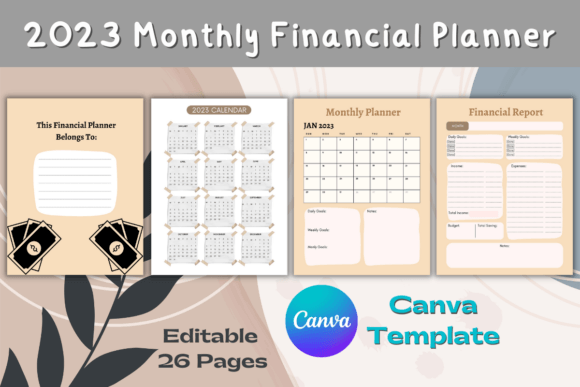
Financial management, especially as a new year unfolds, often starts with aspiration. Yet aspiration without architecture leads to frustration. The difference between a vague intention to “save more” and actually growing your net worth by December is a clear, actionable system. This is the strategic utility of the Financial Planner 2023. It is not merely a calendar or a ledger; it is an editable, printable 26-page framework designed to transform your financial goals from abstract concepts into daily and weekly operational tasks. By providing structured sections for income, expenses, budgets, savings, and notes—integrated with daily, weekly, and monthly goal tracking—it forces clarity. Clarity, in turn, is the prerequisite for control.
From Ambition to Action: How Structure Supports Strategic Goals
Consider the common goal of building an emergency fund. Without a planner, you might simply try to deposit random amounts each month. With the Financial Planner 2023, you first define the annual target in the Financial Report section. You then break it down into monthly savings goals, aligning them with your projected monthly income and budget. Each week, the daily/weekly goals checker allows you to monitor your spending behavior against that week’s micro-target. This process of hierarchical planning—from annual vision to monthly strategy to weekly tactics—is what turns a hopeful goal into an inevitable outcome. For entrepreneurs and freelancers with variable income, this structure is even more critical. It allows you to plan around cash flow cycles proactively, rather than reacting to financial surprises.
Intentional Design for Personal and Professional Finance
The planner’s hybrid nature—offering both printable PDFs for physical tracking and digital files for on-the-go updates—supports varied working styles. Physically writing in the printable version can enhance mindfulness and commitment, making your financial decisions more deliberate. The digital editable version, particularly with the included Canva template, allows for real-time adjustment. This is vital because a good financial plan is not static; it is a living document that responds to reality. The ability to edit colors, elements, and fonts also means you can brand it for professional use. A small business owner, for instance, could adapt the Financial Planner 2023 template to match company colors, using it to track business finances alongside personal ones, creating a cohesive view of their entire financial ecosystem.
Key Components of the Financial Planner 2023 System
Understanding the toolkit is essential for its strategic application. The 26 pages are logically segmented to guide you through a comprehensive fiscal year.
- 2023 Calendar & Monthly Planner: This is your temporal foundation. It’s where you schedule not only appointments but financial events: tax deadlines, investment review dates, quarterly savings milestones. Integrating your financial goals with your monthly calendar ensures they are treated with the same priority as any other critical meeting.
- Financial Report with Daily/Weekly Goals Checker: This is the operational engine. Tracking daily income and expenses provides the granular data most people lack. It’s this data that reveals patterns—the unplanned subscription draining your resources, the side income stream you undervalue. The “Budget and total Saving” section then acts as your control panel, showing you instantly if you are operating within your designed parameters or need to course-correct.
- The Notes Section: Often overlooked, this is where strategy is refined. Why did you overspend in a category? What triggered an unexpected income opportunity? Capturing these observations creates a learning log, turning one year’s financial journey into wisdom for the next.
A Practical Approach: When and How to Use Your Planner Effectively
The most common mistake with any planner is to fill it randomly and then abandon it. The Financial Planner 2023 demands a more thoughtful initiation. Begin before January, or at any quarter start, with a dedicated planning session. Use the first pages to establish your three to five core financial goals for the year. These should be specific, measurable, and tied to life outcomes (e.g., “Save $6,000 for a down payment” rather than “Save for a house”). Then, populate your monthly planner by backward-engineering: if you need $6,000 by November, you must save roughly $550 per month starting in January. Input that $550 as a non-negotiable monthly savings goal.
Your weekly ritual then becomes the review of the goals checker. Each Sunday, assess the past week’s income and expenses against your weekly budget allocation. Did you stay on track? If not, the notes section is where you diagnose the cause and adjust the coming week’s spending to compensate. This weekly cadence creates a rhythm of accountability that annual resolutions alone cannot sustain.
Strategic Considerations and Potential Risks
While the planner is a powerful tool, its effectiveness hinges on your input. A risk lies in using it without first establishing clear, meaningful goals. Filling it with generic targets like “reduce debt” will yield generic results. Instead, use it to implement a specific debt avalanche or snowball plan, detailing the exact debt, the planned monthly payment, and the projected payoff date on the calendar.
Another consideration is the balance between rigidity and adaptability. The planner provides structure, but life provides volatility. A strategic user doesn’t see a missed weekly budget as a failure of the plan, but as a signal to refine it. Perhaps your grocery budget was unrealistic, or an income opportunity arose that allows you to increase your savings target. The editable nature of the Financial Planner 2023, especially via Canva, supports this necessary flexibility. Remember, however, that some template elements are premium; access to the full item requires a Canva Pro account. This is a worthwhile consideration for users who intend deep customization.
Beyond Tracking: Long-Term Value and Integrated Financial Thinking
The true long-term value of consistently using the Financial Planner 2023 is not just in the money saved in one year. It is in the financial mindset cultivated. Over time, the practice shifts your relationship with money from reactive to proactive. You begin to see expenses not as isolated costs but as trade-offs against your stated goals. You view income not just as cash inflow but as fuel for your strategic objectives. This integrated thinking is the bedrock of long-term financial health and independence.
For professionals, creators, and decision-makers, this mindset extends beyond personal finance. The skills honed—breaking down annual goals into monthly actions, tracking key metrics weekly, adapting plans based on data—are directly transferable to business project management, content production schedules, and operational budgeting. The planner, in essence, becomes a training ground for strategic execution in all areas of life.
Making It Your Own: The Power of Customization
The inclusion of multiple file formats (PDF for printing, PDF for digital, JPG) and the Canva template is a deliberate empowerment. The standard 8.5 x 11 inch printable format is perfect for a binder or folder, creating a physical reference point. Meanwhile, the digital files allow you to keep a version on your tablet or laptop for quick updates during a workday. The Canva template unlocks the highest level of strategic use. You can:
- Add sections relevant to your specific context, like a “Business Income” tracker or a “Learning Investment” category for courses and books.
- Change the visual design to make the planner engaging and motivating for you, which increases the likelihood of consistent use.
- Create multiple versions for different roles—one for personal finance, one for a side business, ensuring all your financial streams are managed with the same disciplined framework.
Ultimately, the Financial Planner 2023 is more than a product. It is an invitation to a more intentional year. It provides the architecture, but you provide the vision and the daily discipline. By approaching it not as a simple tracker but as a strategic companion for your financial goals, you transform it from a set of pages into a proven path to the results you seek. The journey to those results starts not with a complex software or a vague hope, but with a clear plan, captured week by week, month by month, on a page designed for exactly that purpose.